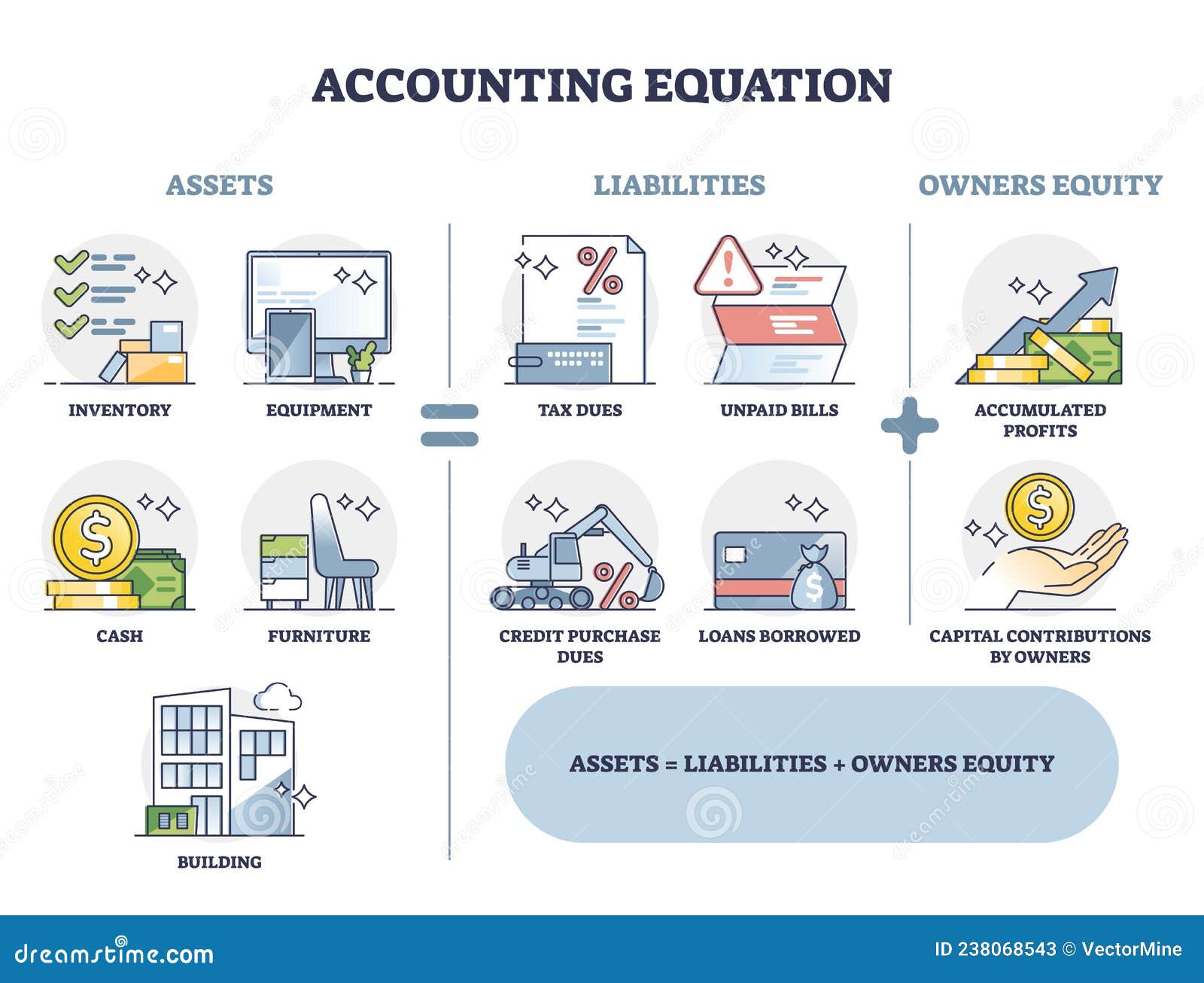

This exercise gives us a rough but useful approximation of a balance sheet amount for the whole year 2024, which is what the income statement number, such as net income, represents. This financial statement lists everything a company owns and all of its debt. A company will be able to quickly assess whether it has borrowed too much money, whether the assets it owns are not liquid enough, or whether it has enough cash on hand to meet current demands. The accounting equation asserts that the value of all assets in a business is always equal to the sum of its liabilities and the owner’s equity. For example, if the total liabilities of a business are $50K and the owner’s equity is $30K, then the total assets must equal $80K ($50K + $30K). The critical thing to remember is that the stuff the business owns (assets) must be equal to the stuff the company owes (liabilities and equity).
Why You Can Trust Finance Strategists


However, due to the fact that accounting is kept on a historical basis, the equity is typically not the net worth of the organization. Often, a company may depreciate capital assets in 5–7 years, meaning that the assets will show on the books as less than their “real” value, or what they would be worth on the secondary market. However, unlike liabilities, equity is not a fixed amount with a fixed interest rate.
- The accounting equation ensures that the balance sheet remains balanced.
- The remainder is the shareholders’ equity, which would be returned to them.
- Every period, a company may pay out dividends from its net income.
- A company usually must provide a balance sheet to a lender in order to secure a business loan.
- For every transaction, both sides of this equation must have an equal net effect.
Financial statements
The fundamental accounting equation, also called the balance sheet equation, is the foundation for the double-entry bookkeeping system and the cornerstone of accounting science. In the accounting equation, every transaction will have a debit and credit entry, and the total debits (left side) will equal the total credits (right side). In other words, the accounting equation will always be “in balance”. Below liabilities on the balance sheet, you’ll find equity, the amount owed to the owners of the company. Since they own the entire company, this amount is intuitively based on the accounting equation – whatever is left over of the Assets after the liabilities have been accounted for must be owned by the owners, by equity.

Accounting Equation in Practice
The accounting equation is the logic behind the double-entry accounting system used on balance sheets, income statements, and cash flow statements. It states that all assets must equal all liabilities plus shareholder equity. A business owns assets and owes liabilities to others and equity to its owners.
Create a free account to unlock this Template
Gross Domestic Product (GDP) is the total value of all goods and services that a country produces in a set period of time. He funds the venture with $10,000 of his own money and takes out a small business loan for $30,000. Each entry is reflected in at least two places, like two sides of the same coin. They tell a different story about what happened to the same value.
We follow strict ethical journalism practices, which includes presenting unbiased information and citing reliable, attributed resources. The articles and research support materials available on this site are educational and are not intended to be investment or tax advice. All such information is provided solely for convenience purposes only and all users thereof should be guided accordingly. 11 Financial is a registered investment adviser located in Lufkin, Texas. 11 Financial may only transact business in those states in which it is registered, or qualifies for an exemption or exclusion from registration requirements. 11 Financial’s website is limited to the dissemination of general information pertaining to its advisory services, together with access to additional investment-related information, publications, and links.
This straightforward relationship between assets, liabilities, and equity is considered to be the foundation of the double-entry accounting system. The accounting equation ensures that the balance sheet remains balanced. That is, each entry made on the debit side has a corresponding garmin fenix 5 entry (or coverage) on the credit side. As such, the balance sheet is divided into two sides (or sections). The left side of the balance sheet outlines all of a company’s assets. On the right side, the balance sheet outlines the company’s liabilities and shareholders’ equity.
Everything listed is an item that the company has control over and can use to run the business. If a transaction is completely omitted from the accounting books, it will not unbalance the accounting equation. This number is the sum of total earnings that were not paid to shareholders as dividends. It can be defined as the total number of dollars that a company would have left if it liquidated all of its assets and paid off all of its liabilities. Suppose you decide that if you offered coffee as well, you’d probably get more doughnut sales. The loan from your cousin is a liability because the business is obligated to pay it back.